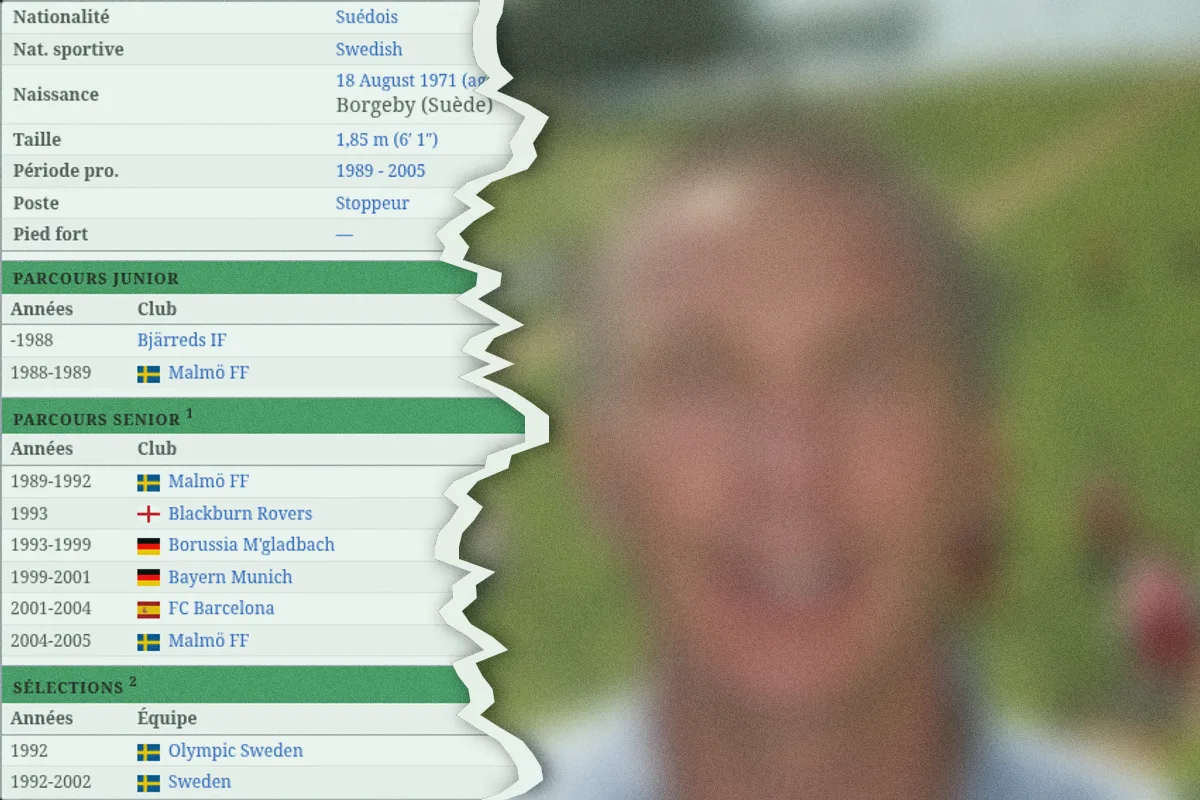
The hard player: Patrik Andersson
Born on 18 August 1971 in Borgeby, Sweden, Patrik Jonas Andersson was a no-frills central defender who made his mark across the major stages of European football. He cut his teeth at Malmö FF (90 matches, 11 goals) before settling in the Bundesliga with Borussia M’Gladbach, where he played 178 matches and scored 11 goals – an old-school centre-back who could also make himself felt going forward.
The second half of his career took him even higher: Bayern Munich (58 matches, 1 goal) and then FC Barcelona (29 matches, 1 goal). He also represented Sweden’s Olympic side (4 matches, 1 goal), and eventually returned to where it all began – Malmö FF – rounding off a rich journey through three of Europe’s most demanding leagues.
Discovering Le Roi des Footix? Identify 3 football players a day, climb the leaderboard, become the Roi des Footix.
PlayThe medium player: Gaizka Mendieta
Born on 27 March 1974 in Bilbao, Gaizka Mendieta Zabala is the archetypal midfielder who experienced it all: glory, near-misses in European competition, and the comedown that followed. It was at Valencia that he built his legend, playing 305 matches and scoring 59 goals in the famous yellow and black – a remarkable return for a Spanish-style central midfielder.
After Valencia, his career became more unsettled: a stint at Lazio in Rome (27 matches), before moving to Middlesbrough (45 matches, 3 goals) and a loan at FC Barcelona (47 matches, 6 goals). A winding road that kept him out of the spotlight, yet he remains a defining figure for a whole generation of Spanish football fans. He retired from playing in 2008 and went on to work as a pundit for the British broadcaster Sky Sports.
The easy player: Pauleta
Born on 28 April 1973 in Ponta Delgada, in the Azores, Pedro Miguel Carreiro Resendes, known as Pauleta, built his reputation as a clinical striker far from the big football capitals. After coming through in Portugal with Estoril-Praia, he headed to Spain: first to Salamanca (75 games, 34 goals), then to Deportivo La Coruña (78 games, 22 goals), sharpening his finishing along the way.
France is where he truly soared. First at Bordeaux, where he netted 91 goals in 130 appearances. Then at PSG, where he became the club’s go-to striker with 109 goals in 211 matches. Back in Portugal, he was known only as “the Eagle of the Azores” – a nickname inspired by the way he celebrated his goals, gliding like a bird of prey, and by the goshawk featured on the flag of the Azores.