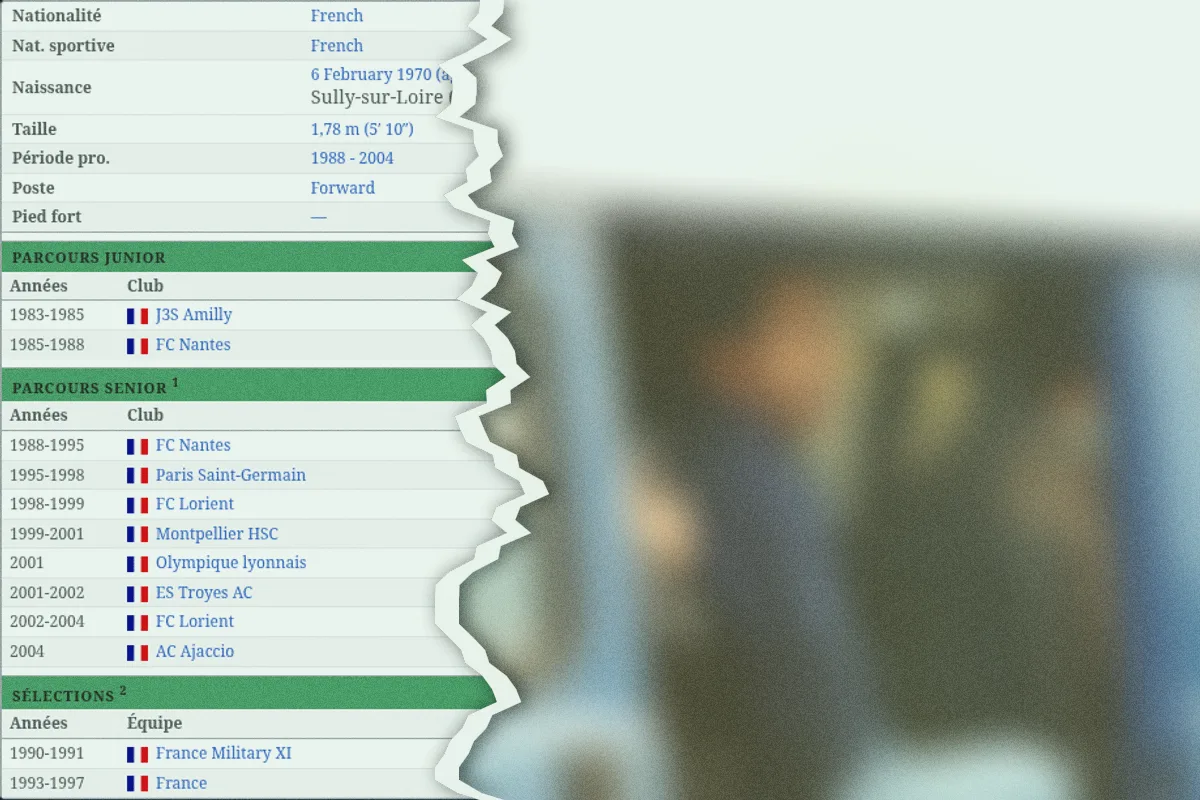
The hard player: Patrice Loko
Born on 6 February 1970 in Sully-sur-Loire in the Loiret, Patrice Loko is a striker who built his reputation along the banks of the Loire before making his mark across Ligue 1. It was at Nantes that he laid his most important foundations: 206 appearances and 49 goals for the Canaries, a solid platform that opened the doors to the capital.
At Paris Saint-Germain, he kept up the pace with 115 matches and 36 goals. His professional career, which ran from 1988 to 2004, also took him to Montpellier (41 appearances, 11 goals), Troyes (34 appearances, 12 goals) and Lorient (58 appearances, 13 goals), racking up miles and goals from one end of France to the other. A French international, he also represented the France military team in a single appearance. A rich and varied career, from the Loiret to Paris, that 93% of players managed to piece together.
Discovering Le Roi des Footix? Identify 3 football players a day, climb the leaderboard, become the Roi des Footix.
PlayThe medium player: Michael Carrick
Born on 28 July 1981 in Wallsend, England, Michael Carrick is a defensive midfielder whose career unfolds in three chapters. He learned his trade at West Ham United (159 appearances, 6 goals), before a stint at Tottenham Hotspur (75 appearances, 2 goals), and then signed for Manchester United, where he spent the prime years of his career: 464 matches and 24 goals in the famous red shirt at Old Trafford.
Quiet but indispensable, Carrick represents the kind of player supporters underrate and coaches treasure. His international career was limited to youth level, earning 4 caps for the England under-18 side. After hanging up his boots, he moved into management and took charge of Manchester United, the only club that ever truly felt like home.
The easy player: Abedi Pelé
Abedi Ayew, known as Abedi Pelé, was born on 5 November 1964 in Dome, Ghana. A playmaker capable of operating through the middle, wide, or even as a supporting striker, he established himself as one of the defining figures of African football in the early 1990s. Three consecutive African Ballon d’Or awards (1991, 1992, 1993) rewarded his decade of continental dominance.
It was at Olympique de Marseille that he etched his name into European history: 150 appearances, 30 goals, and most importantly the 1993 Champions League triumph, proof that he was one of the first African players to make a real mark on European football. With Ghana, he earned 73 caps and scored 19 goals, having already won the 1982 Africa Cup of Nations. His legacy goes beyond the pitch: his brother Kwame Ayew and his sons André, Jordan and Rahim Ayew all carried the family tradition forward at the highest level.